Sanitation
The Trash Man cometh
Somebody needs to write a book titled "Everything You Ever Wanted To Know About
Sanitation And Were Afraid To Ask". I'm not volunteering to take on such a task, but as you
enter the future we face, these essential aspects of life might well depart radically from
American custom.
The junk that our society produces often spells opportunity for third-world countries. In one
port the labor to repaint our entire ship (a old destroyer about 300' long by 30' wide) was
exchanged for the garbage from our mess hall during our four-day stay in port. I suspect that
we ate some of this very food when we patronized local restaurants, but it seemed like a good
idea at the time.
Our vast landfills are monuments to poor planning, wasted materials, and wasted effort.
High-technology and prosperity are beautiful things, but we need to be more responsible in
managing the by-products.
It is unrealistic to expect that we can anticipate the full impact of everything we create, but
what we can do is give serious attention to systems that will manage various categories of
waste. The goal should ultimately be a zero-emissions society, in which nothing returns to the
earth in a poisonous state, and without having repeatedly yielded service. If such systems are
built into a society from the start, landfills would be reduced by the increasing opportunities of
recycling. In the idealistic long run, this might mean that initial product designs would also
consider a product's ultimate disposal.
What I envision as practical on a household or micro-community scale, is a well-planned
system of recycling. This particular project by the way, would be an excellent one for
children to become involved in. After all, it is their future we are concerned about, and it's
important to teach them how to protect it.
Designate an area – preferable visually screened – and set up containers and locations to
accommodate the following categories:
1. Redemption value: Besides the well known cans and bottles,
plan to save these materials in other forms, such as foil and
plastics.
2. Compost: Anything organic, other than scraps of wood or meat.
3. Combustible: Wood, twigs, natural fabrics, and paper.
Arguably, such things as plastics and oils might be considered.
Be careful though, most of these materials produce toxic
byproducts when burned, and should be recycled by other means.
4. Marketable: Outgrown, outmoded, outcast -- give it or sell
it.
5. Repairable: I would suggest protecting any useful object that
is potentially repairable, even if the tools, talent, or mate-
rials are not on hand at the moment. As a community develops
these things might become part of a combined resource for which
talent, time, and tools would become available.
6. Parts salvage: This one would overlap the "repairable" group
on the lower end. This could become a resource for the development
of additional alternative technologies, and for the repair of
other items.
7. Materials salvage: Various types of construction materials,
large pieces of metal, plastic, glass, wire, pipe, etc.
8. Hazardous materials: Salvage suitable containers for the
storage of any hazardous or dubious chemical compounds. Be sure
to identify all contents and avoid any mixing. Save any labels
that identify chemical contents.
9. Grey-water: This refers to any used wash water that hasn't
been in a toilet. This should be stored in a tank, and used to
water your garden.
I am sure some materials will wind up as structural fill, but even keeping that category as
well sorted as possible would increase its' potential usefulness. We would do well to build
habits of economy and conservation into the very foundation of the life we are building.
Le John
One of the most critical concerns for homeless living is sanitation. I'll leave it to your
imagination do draw the ugly pictures for this one, and proceed to the most rudimentary of
solutions.
The pits
I spent a couple of months one year living in a tent while working construction in the
Colorado Rockies. The running water I had (running a few feet from my tent) was OK for an
icy bath, but it wasn't trained to flush a toilet. I used a sharp stick to loosen soil and rocks, and
used my hand to dig a 6" diameter pit as long as my arm; I guess that's why I called it an arm
pit. Brush in a little dirt after each use and you will eliminate insects and odors; you would
never know it was there, unless you're into sleep-walking.
Under such conditions aerobic bacteria eliminate pathogens and odors in the material itself
with in a very few months, leaving clean and valuable compost. I would suggest that trees would
be the optimum beneficiaries of such pits in that there would be less probability of
later excavations nearby. Theoretically it wouldn’t matter after a few months – but still.
If you happen to be in rattlesnake country, please check the hole before using. You might
have to run a long way before you'll find someone willing to suck the poison.
As for toilet paper, you'll just have to use your head on that one. That's obviously what our
politicians do, because the quality of the paper they generate is far too poor for such
purposes. Different cultures have different solutions to this problem. I have noticed that in
most parts of the world people tend to nod and bow a lot, rather than shake hands -- I never
insist. Rural Moslem's have good reasons for doing very little with their left hands; they have
such hygienic considerations built right into their religion.
That's not to say that insulation is never used, I myself have handled leaves that even
Charmin would envy. I also know of at least two campers who will never again forget
what poison oak looks like!
Plan ahead when locating your pit. First of course, be sure that it's not next to your well ;
let's be reasonable about this recycling thing. You should also consider a location where you
are not likely to be doing any digging for a few months. If your plan includes an eventual
garden in the area, be sure and fill in the top of the pit before it becomes less than a foot deep.
Another possibility would be to favor a tree with these deposits, using root entangled areas
where a garden or structure is not likely to grow.
It is surprising how long one of these pits can be used before it fills up, but eventually you
are going to want to move the hole thing. So plan your sequence of holes ahead of time, and
be sure to mark the used places with rocks or stakes, or else digging new pits will soon
become the least popular job in camp.
Auger
What worked fine for a construction worker with three million acres to choose from would
not be quite as practical in a crowded homeless camp. I would recommend obtaining a tool
capable of boring down about six or eight feet. A common two-handle post hole digger is a
good place to start, but the depth is limited.
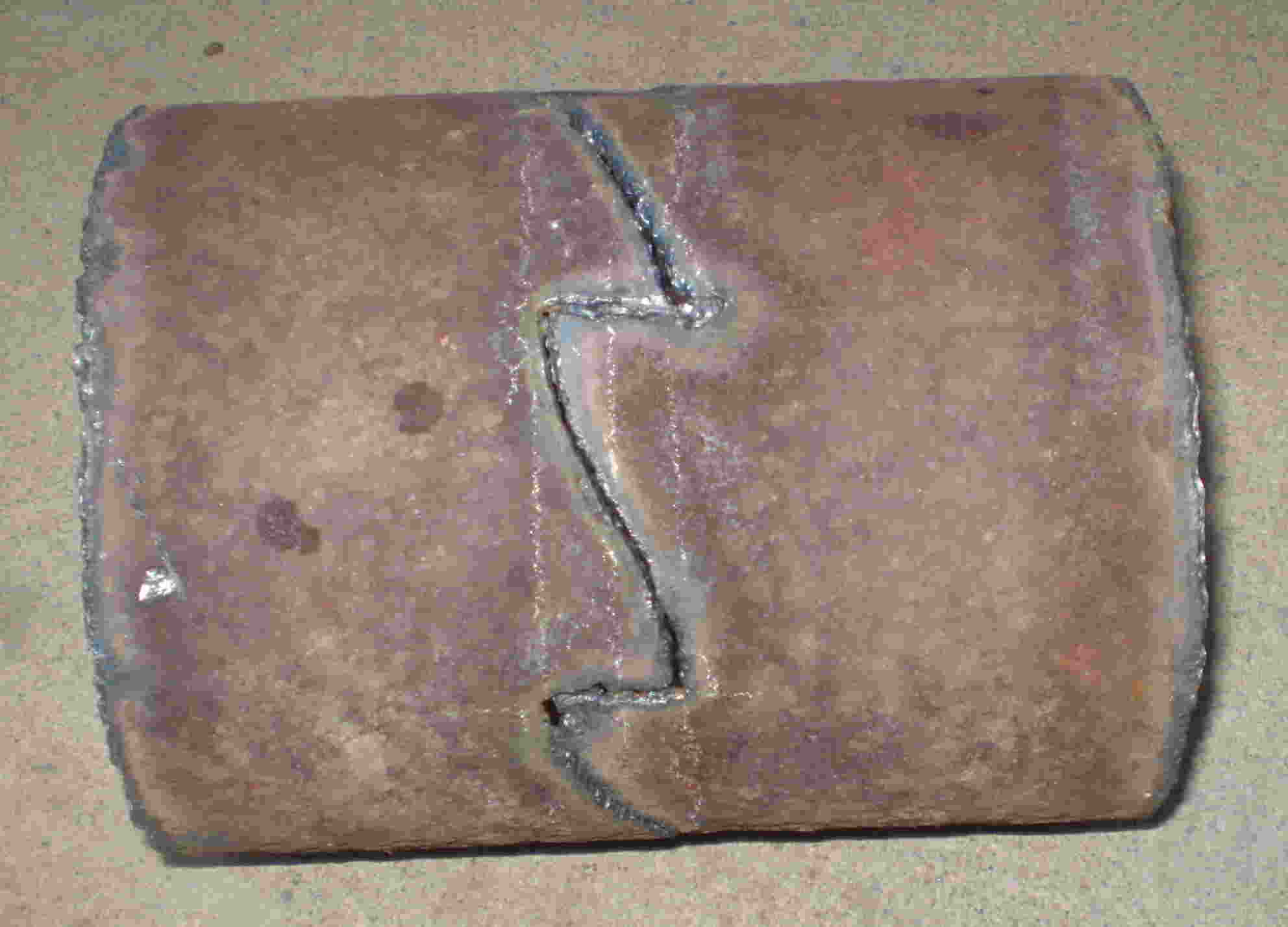
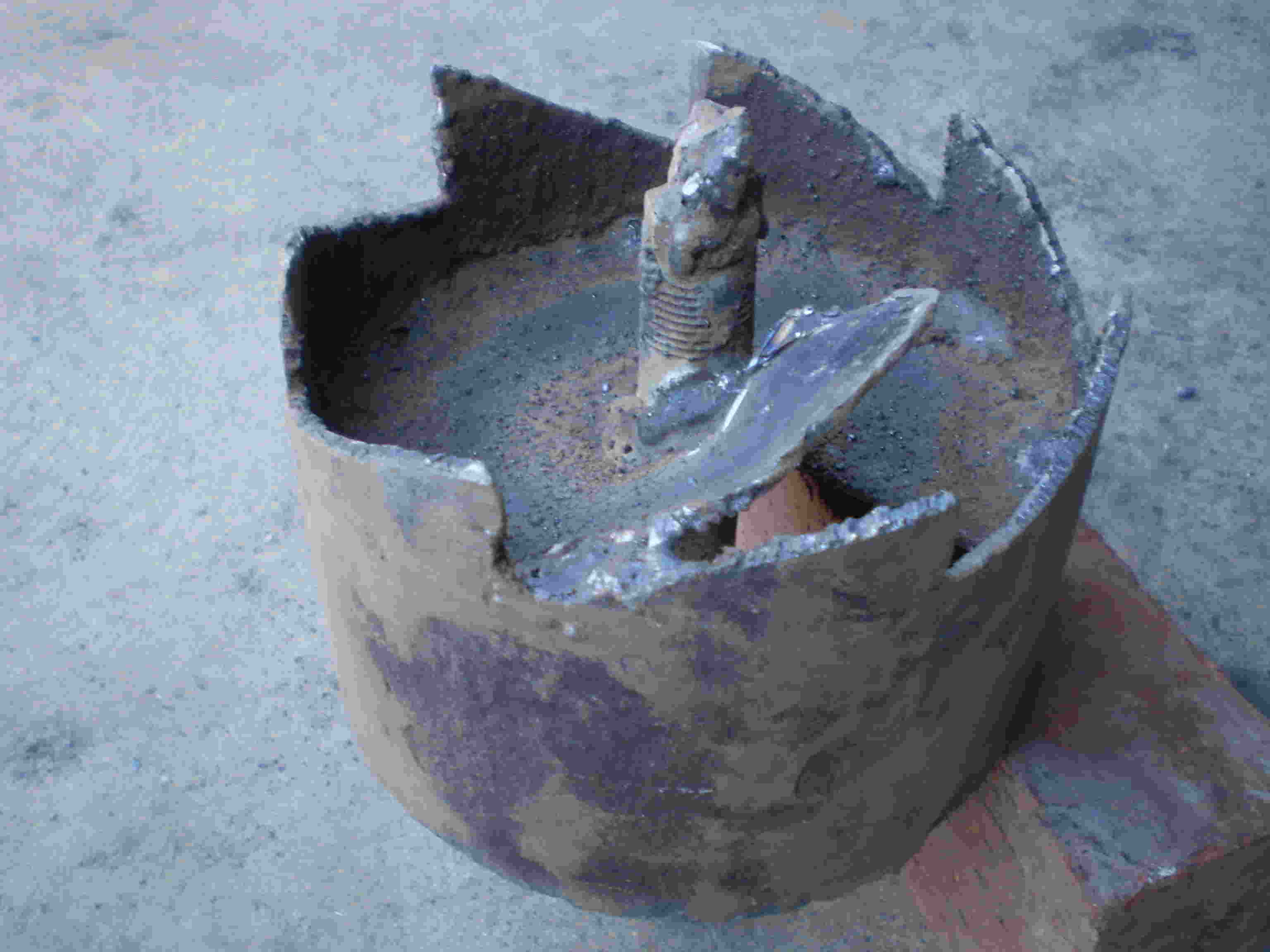
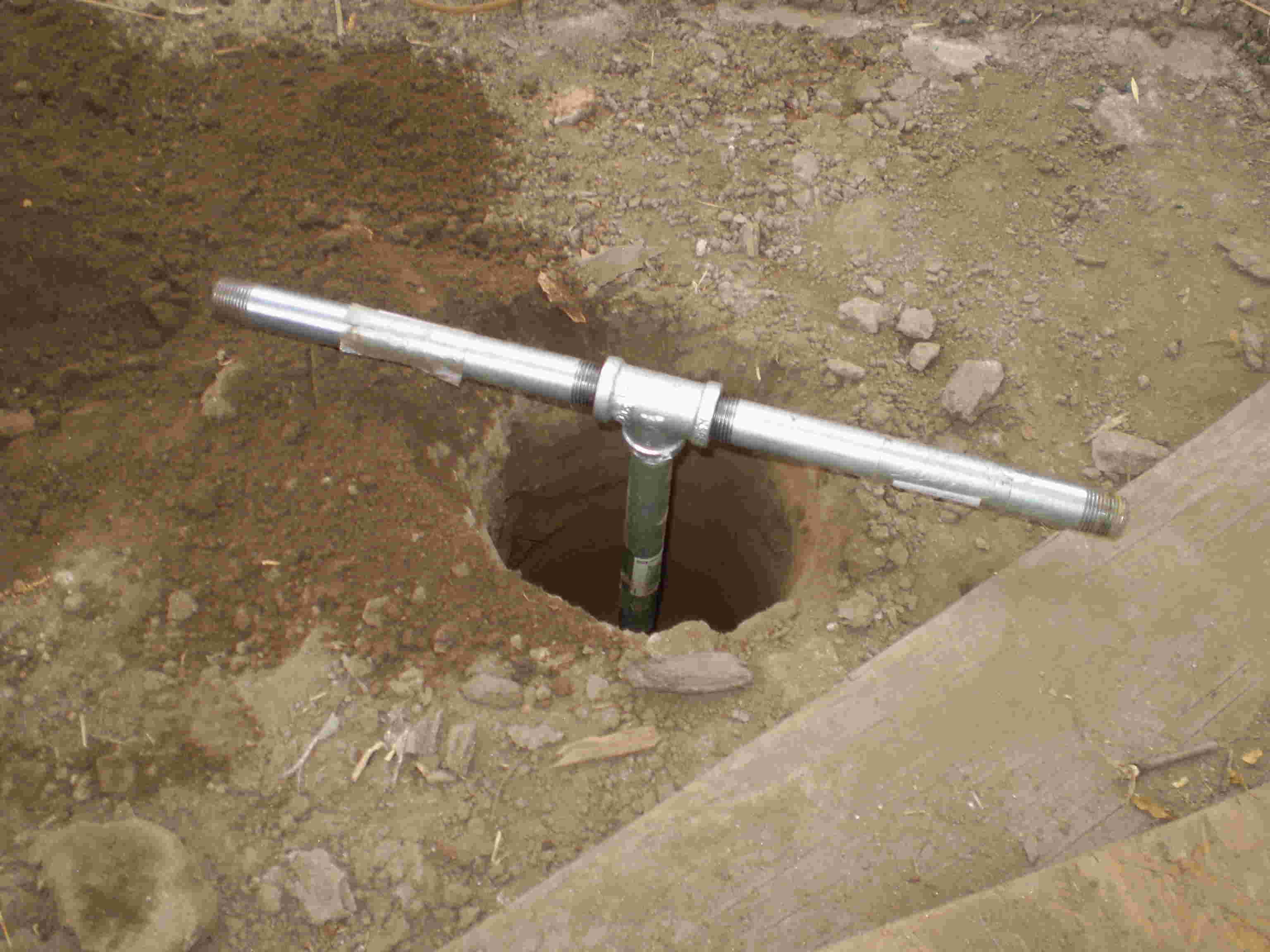
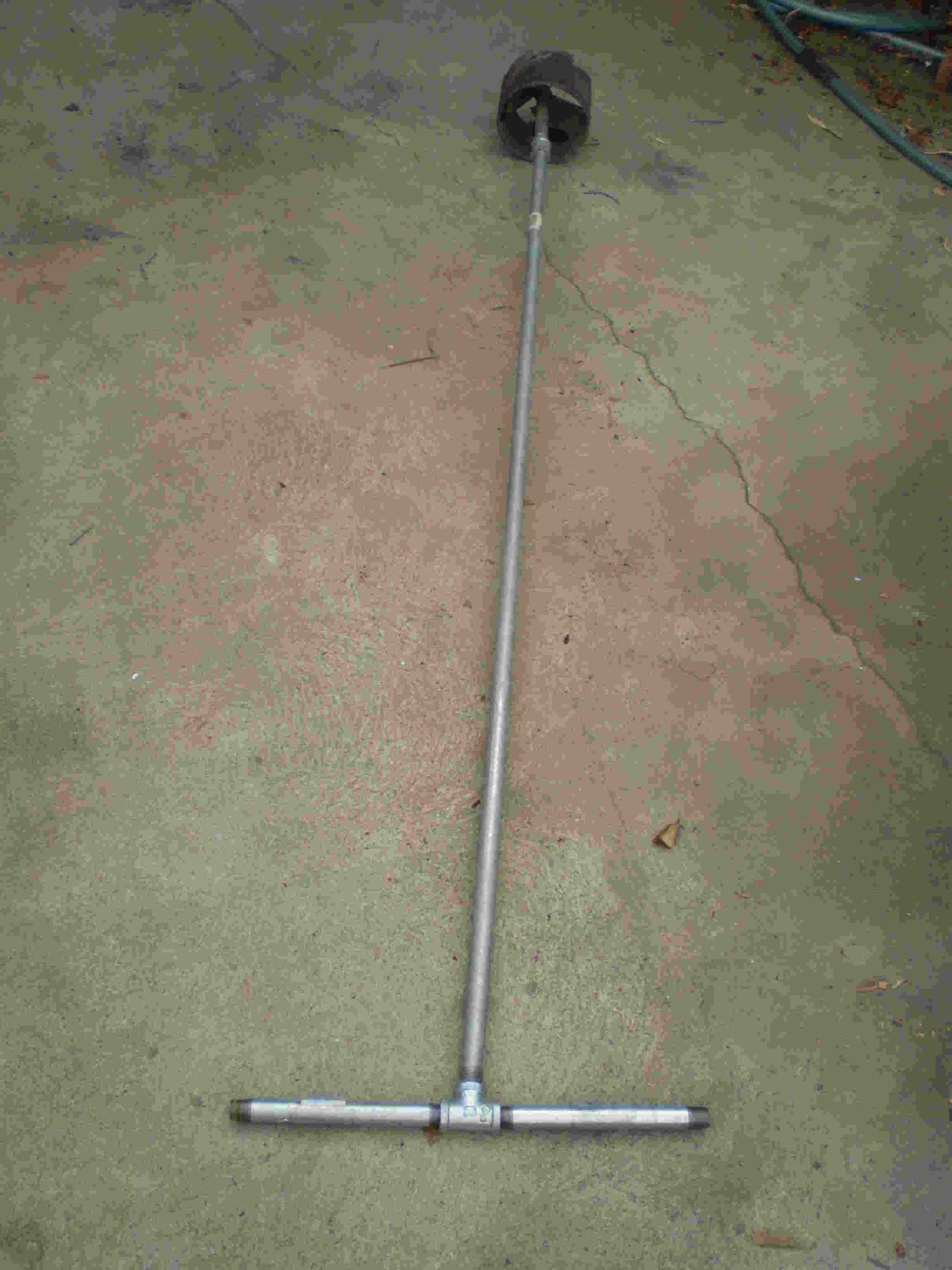
There are auger-style post-hole diggers to which additional pipe can be added to reach any
depth you want. For my part, I've begun experimenting with home-made versions, and
although I'm not yet entirely satisfied. I'll share what I have so far in the pictures to follow. I
won't insult your intelligence by describing the obvious here, I'll let the pictures add the
“thousand words.”
I would recommend a diameter of about eight or ten inches to be large enough for a
worthwhile capacity, yet not big enough to fall into – but do keep track of your wallet.
The above-described latrine can be a handy immediate solution, but in the long run – if there is
a long run – it would be much better to invest a little more effort to dig out a pit several feet deep
and three feet or so in diameter. Build up the sides with un-cemented rock work, and then taper t
he rocks inward at the top to an opening about 12" in diameter. This is covered by a board or
cement casting containing a slot of about 6" by 10". Keep this covered with a board when not in
use. The board should be fitted with hardware that would allow it to be removed and replaced
using only your foot. I read of one such arrangement where this cover was actually hinged to the
base, and was easily tilted up out of the way my means of an attached pedal.
I would strongly advocate a departure from Western posture when using such facilities. It is far
more sanitary to make no contact other than the soles of your feet. You will also find the deep
squat a surprisingly comfortable position. It's obviously the way we were designed.
Privacy
Although sanitation is critical, self-respect is also extremely important. In the excruciating
circumstances of some crowded homeless camps, there is simply no place to hide – a real
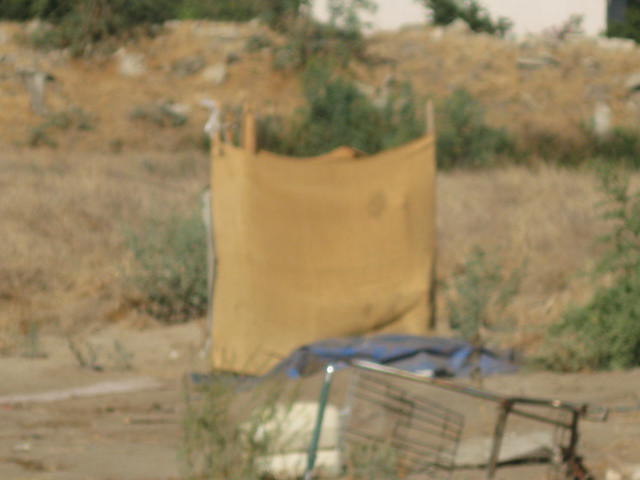
situation that we would rather not believe could exist in America today. The first photo shows a
solution developed by residents within a homeless camp, and there are endless other ways of
solving this problem.
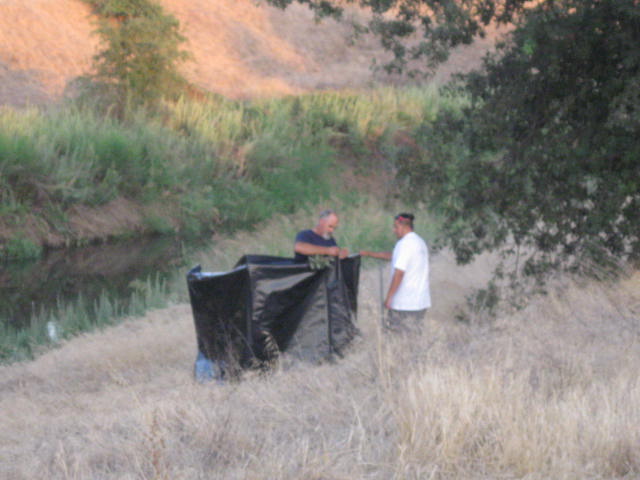
A simple privacy curtain can be made by cutting three ten-foot lengths of 1/2” or 3/4” metal
conduit in half and driving the bottom foot of them into the ground around your pit. Arrange
them in about a five-foot square, with the two remaining posts spaced for an opening and a view
blocking overlap. Cut a four-foot wide piece of black plastic for the curtain itself, and secure as
required with duct tape. This would still be far below our preferred privacy standards, but it's cheap
and easily moved.
Bathing
I did an experiment for a couple of weeks in which I bathed using two gallons of solar heated
water diluted to a usable temperature with cold water. The technique was to use warm suds in a
pool about an inch deep in the bottom of the tub.
I was surprised that I was able to get a very thorough bath and rinse, and still have hot water left
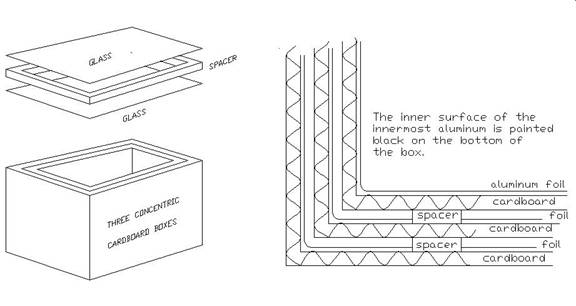
over. As an added bonus, I was heating this water in a cardboard box! The contraption was
basically three layers of foil-lined cardboard, with a double layer of glass over it. Don’t
underestimate the value of the foil. Although totally lacking in insulating value, shiny aluminum
reflects infrared radiation. Considering that thermal radiation increases with the fourth power of
the absolute temperature, infrared loss can be significant at higher temperatures.
What was merely intended to demonstrate comfortable sanitation with a small amount of solar
heated water, also proved that water a couple inches deep can provide a very thorough bath.
I haven't tried this yet, but I would expect that a limited amount of laundry could be done in this
same setup.
Within a 4'x 8' base frame of a pre-fab panel shelter, I framed a 24" x 36" box with a gently
sloping bottom of 3/4" plywood. When fitted with a drain, and lined with a rubberized roof-coating,
the 4'x 8' shelter had a bath tub. Now of course I had to test it before I could write about it: I
discovered that although 24" x 36" is large enough for 6' x 170 lbs, it's also small enough that the
bath gets shared with nearby walls etc.
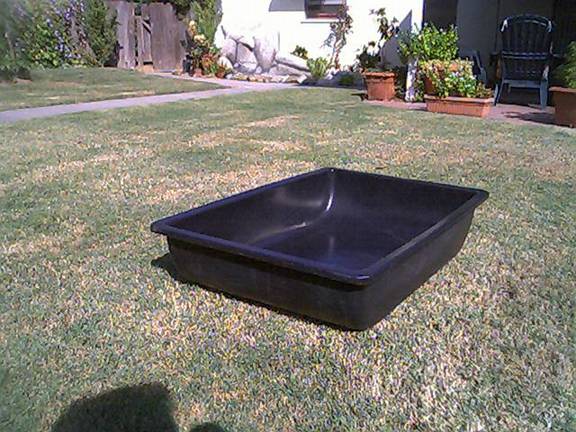
A very practical variation of this pan it to simply buy a plastic trough designed for mixing cement,
from your local building-supply store. This way you can bathe out on your front lawn and leave
your dwelling dry. Seriously though, we have in fact used such a pan for bathing while camping out.
The water was heated in a couple of black-painted gallon milk jugs. They were resting on a
shallow sheet-metal pan also painted black. With this cheap simple arrangement, water would still
be too hot to use directly for some time after sunset.
When I returned to a more "civilized" bathing pattern, I began using it as a solar cooker, and found
nothing I couldn't "crock-pot" during the course of a day. These challenges included beans, and
even baked potatoes. For proper cooking, the food needs to be in a dark container. The cheap black
or dark blue enameled cookware common to supermarkets and second-world countries is ideal.
In all fairness, I need to add that most of these experiments took place during the summer time,
but the potential for year-round usage is obviously there.
Another important detail is that it must either be propped at an angle so the sun can shine directly
into it on its path, or set up with some kind of a reflector arrangement.
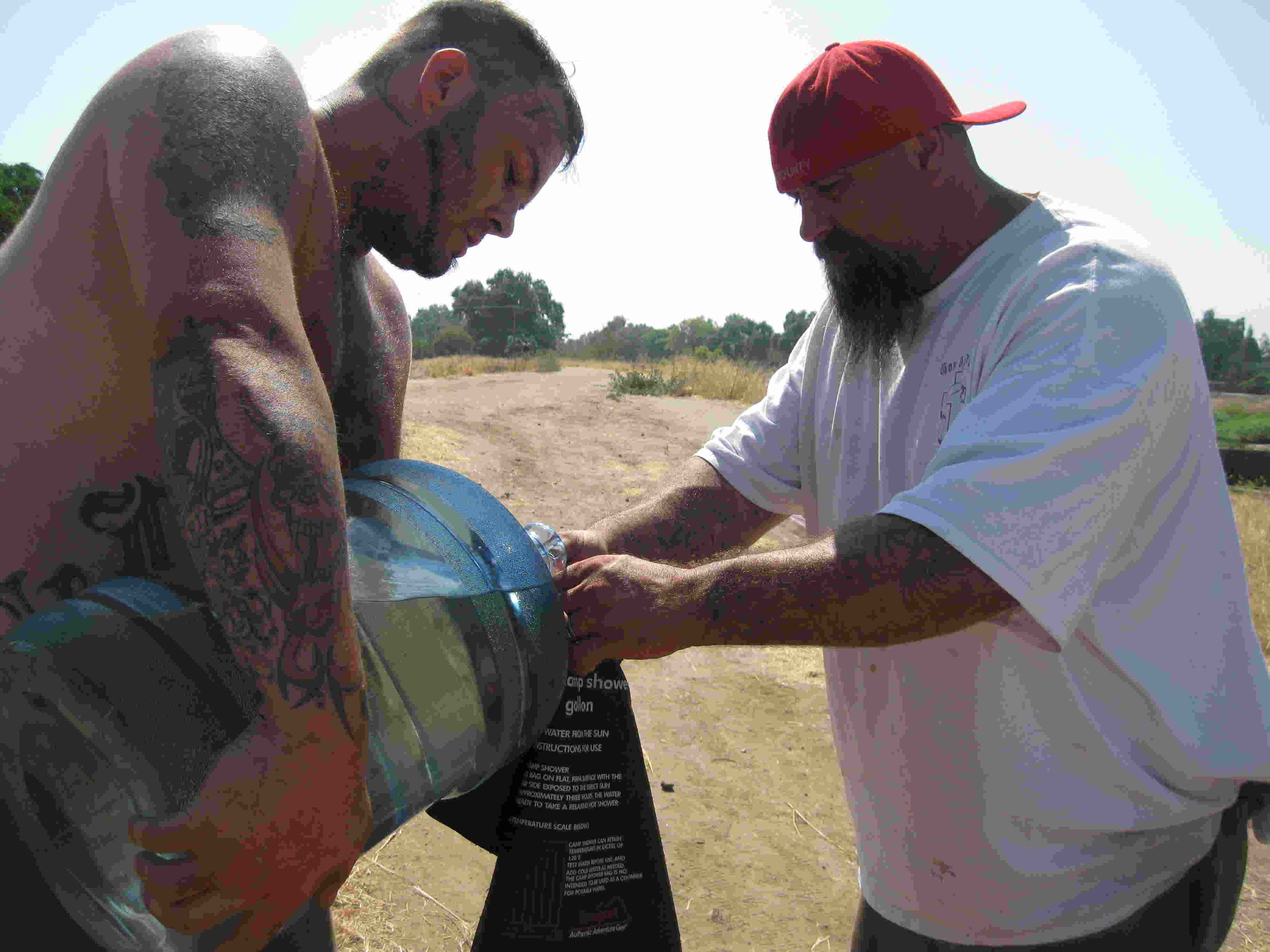
Another option is the use of elevated black containers of water that can be heated directly by
the sun. A small shower head is attached
Germ Control
In contemplating a sustainable lifestyle, I have considered a wide range of possible situations.
These ideas extend from subtle adjustments to the American dream, to groups of people sharing
any available resource.
Picture several families combining their resources and talents to survive. One of these families
has a bolt-together dome, another found tools and materials for a cook-stove, and another was
able to develop a source of water.
The dome becomes the common kitchen, shower, clubhouse, library and shop. The actual sleeping
takes place in small tents, cars and makeshift shelters. Combine these conditions with a less-than
familiar sanitation system, and you have the potential for the rapid spread of disease. Here are
some ideas that could help.
1. Minimize physical contact outside your immediate family --
nodding and smiling might replace the handshake under certain
circumstances. Seriously consider adopting the Moslem custom of
keeping your right hand clean at all times.
2. Discipline yourself and instruct the children in properly
covering and directing coughs and sneezes. Improper etiquette
could be more than rude in some cases.
3. Clean and keep your own personal table service -- these
shouldn't be shared without special cleaning. During the
nineteenth century, in some parts of this country, many people
carried their own spoons with them.
4. thoroughly scrub and sun-dry clothing that is to be given
away or shared.
5. Do not share towels or wash cloths.
Other Pests
Insects etc. can be a problem in a society without an abundance of screens and spray cans of
sweet-smelling insecticide, but we are not entirely helpless here either.
The first and most important line of defense is to keep things clean. Be sure that all food is
stored in bug-proof containers, and that any messes be cleaned up without a trace. Personal
hygiene is also very important.
But should there be ants anyway, a dash of boiling water is a safe, clean way to dispose of the
visible ones. Insect nests may be a little harder to reach, but at least you have something to fight
with. It would be helpful if someone could develop a portable device that could blast hot steam into
nooks and cracks.
In open areas, red ant hills are notoriously hard to kill. You might try soaking the area with a
gallon of boiling water, but I have found that about a pint of gasoline can shut everything down
instantly. Don't light it right away, just let it soak for an hour or two. The only reason you need to
light it is to get rid of the gasoline.
Sorry children, pets can be dangerous for their infestations of fleas and other pests. This is
especially true if they are the kind that are likely to come in contact with rodents. During the dark
ages Europe was repeatedly ravaged by waves of bubonic plague, which we know now was
carried by fleas. Within this country there are sporadic cases of bubonic plague and other deadly
diseases that are spread through the fleas which are carried by rodents.
Maybe it's like the crackle of mosquitoes as they enter the high-voltage grid of a U.V. lamp on a
patio, but there's a certain satisfaction in not being totally helpless against invading swarms,
 without
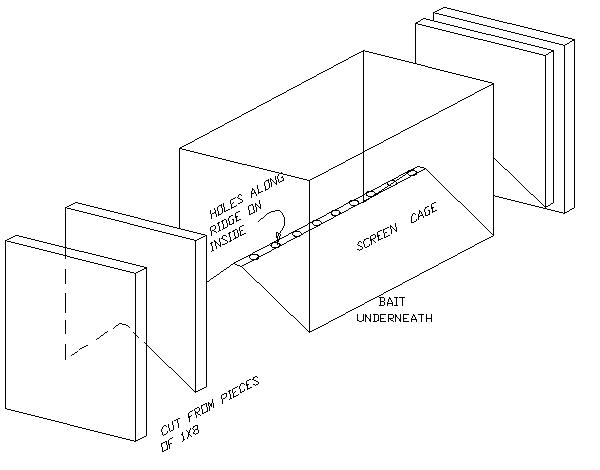
using bug poisons. As a child I remember
-- I think it was my grandfather – setting up this
without
using bug poisons. As a child I remember
-- I think it was my grandfather – setting up this
simple screen box that protected our picnic from at least some of the flies.
The box is set over some bait,
about 3/4" above the surface. A
percentage of the flies, after their
final meal, travel upward through
the holes along the ridge in the
center of the box, and never find
their way out. I was told that it
would be even more effective if
the top surface was made of glass.