Organization & Society
A community with a good quality of living that is not dependent upon external resources for its’ basic needs (of food, water, shelter, and energy) could make a significant political statement. A network of such communities would be a political force to be reckoned with, and could lead the region to a better world.
Phase 1 Organization
An individual living alone on the street lives a very precarious existence. He dare not leave his belongings stashed, or they will likely be stolen. He is in danger of being robbed, and has no one to stand beside him. He is also quite vulnerable while sleeping.
There was a period when I would occasionally sleep alone on a beach near the Mexican border, and have personally experienced such fear and stress first hand. Instincts and senses get well tuned in such times, and waking such a person can be extremely dangerous. I knew a man who left a stab wound on a prowlers face, and I saw one man knocked several feet when the one he awakened feigned sleep log enough to ascertain the target. But in any case, it remains extremely dangerous to sleep on the trail alone.
With a friend, you have power and protection. With a group of friends you have little to fear, and can begin to develop a synergistic community. Sharing and community-related functions develop voluntarily and naturally under minimalist conditions.
Phase 2 Organization
I believe that definitions of government types are best left to merely describing organizations, rather than as targets to which people would be urged to comply. An optimal government style could simultaneously or sequentially bear many such labels – for instance:
A community would be a republic to the degree that people would have complete control over their own lives and resources.
It would be a voluntary form of communism to the degree that people chose to share their resources and work towards a common goal. The early Christian church was a form of communism in that people freely shared what they had with all who were in need – even to the point of selling houses and property.
On the other hand, history does not have a more consistently proven economic failure than state-mandated communism. When people have their productivity forcefully taken from them, and given to less productive people, nobody is motivated to produce. Nobody benefits from being productive, and if you choose to sit on your butt, you will have all you need anyway.
In such cases, few experience the warmth and privilege of giving because the needs have been covered by funds extorted from them. Compassion and personal involvement have been replaced by resentment and disdain. On the receiving end, gratitude is replaced by an attitude of entitlement, absolution from all responsibility, and the contempt a successful con has for its gullible mark. Such attitudes are rampant today in our socialized democracies. We must meet the needs of the poor in a manner that does not breed corruption and rot the soul of a society.
Even the Mayflower adventure was a miserable failure until each person was given their own private land to develop.
Voluntary communism on the other hand, is a good thing. We should have compassion on the less fortunate, and we should be proud to be a part of a movement that can improve life for everyone. In a true community where there is interdependency, we can’t afford to just bail out our end of the boat.
It would be a democracy when it came to those who contributed to public resources voting on how they were used. This may sound un-American, but those who stay put and contribute would be far more interested in community benefit, than visiting non-produces and non-contributors voting themselves welfare raises.
It would be tenant farming for those who could contribute nothing, were in need of help, and were willing to work. Such a condition would be temporary however, in that it would empower them to develop personal resources and rise above their poverty.
Laws would be held to an absolute minimum at all levels of development. Acceptable levels of sight, smell, and sound would be understood and honored by all. I don’t want to see your trash, I don’t want to smell your garbage, and I don’t want to listen to your boom-box – or your domestic squabbles for that matter.
Committees and Specialists are needed in a variety of areas, such as village planning and agricultural, and utility operations. Cases where experts are available should not be screwed up by uninformed democracy. If your experts prove to know what they are doing, trust them. If they don’t help, or if they insist on keeping secrets concerning public funds and activities, let democracy fire them.
Phase 3 Organization
Each village determines their own government. A wealthy individual might want to dabble in dictatorship as a hobby, build a village and invite those who would accept himself as boss. A religious community, a nudist colony, communism, or even experiments with democracy might be attempted. All could coexist in adjacent communities, as long as any visitors knew what to expect.
This brings up an interesting point. It would suit America well to teach children about the differences in the various cultures in public schools, and the etiquette for getting along. I have been places where some people would be annoyed if you did not honk your horn under certain circumstances (I guess it was considered discourteous to run over a pedestrian before warning him). In most of our culture, the horn is most often an expression of anger.
Government should be as minimal as possible. Laws should apply only to community resources, and protect against violations of persons and their property. A token structure consisting only of local residents may be provided to deal with external governmental impositions. Such would also field any law enforcement needs.
Security
Phase 1 Security
There would not be much to steal at this level, but what you do have may be essential to survival. You don’t have walls or lockable buildings, so you’re going to have to depend upon each other; this too is a mixed blessing. Solitude is vulnerability, and no significant future is achieved without involving other people. This is just one of many reasons to think in terms of community.
For many without homes, there is no legal place to live. Protection from being hounded by those more fortunate, hinges upon concealment.
If you manage to collect a little spare change and a few tools, you might want to adapt a project I have used to train neighbors’ dogs not to bark. This project can basically replace a dog in that it hears a sound and responds with one. By adding a little sophistication you might be able to teach it to say “arf!”, or quote the sound of a 12-gauge shotgun chambering a round. The advantage is that you don’t have to feed it. On the down side, I’ve never been able to teach one of these things to bite.
Phase 2 Security
This level is defined by the building of permanent structures. This is a very critical stage; the future of the entire enterprise hinges upon how land is allocated and the style of the structures themselves.
During travels in Latin America, I was impressed with how secure and logical much of the housing was.
In the U.S.A., we pay for front yards that we are financially & physically enslaved to maintain for the sake of the neighbors. We have five-foot wide strips of land on each side of our houses that give burglar-access to our back yards, which cannot legally be protected by more than a six-foot-high fence.
Besides depriving ourselves of our individual choices on how we might like to use the land we are buying, we have these city-mandated burglary-enhancement features.
In many Latin towns, the edge of the sidewalk is met with a three-foot-thick adobe wall, about eight or ten feet tall. These walls are topped with broken glass, and sharp pieces of iron. Some or all the length of this outside wall is also a wall of the house.
That which we use-up in front yard and burglary-access strips along the sides of our own houses is all combined into one large, very private back yard in their case. Some of these back yards are incredibly beautiful combinations of flowers, vegetables, fruit trees, and naked little kids.
The door is typically about 3" of solid wood, and any windows in the wall are protected with decorative Ironwork. In some cases a wall might have a massive gate to allow the entrance of a vehicle. This makes it difficult for a burglar to even determine whether or not someone is home without obviously peering through a crack in the gate opening (assuming it hasn’t been visually obscured).
The burglars that plague our cities would go pretty hungry in this environment. Another security aspect to consider is that a fleeing robbery suspect would have a hard time fence-hopping to avoid police, and very few stray bullets from your friendly neighborhood drive-bys would find their way through three feet of adobe.
This structure style is inherently resistant to burglary and is an excellent example of passive crime control through technology. This passive approach avoids confrontation, optimizes personal privacy, and minimizes the burden upon law enforcement services. As a general policy, it would be prudent to consider passive forms of security at all levels of design.
America is not friendly towards privacy however, but maybe one could get the zoning required to build a garden-of-Eden back yard home in a burnt-out industrial area. It would really be neat to get an urban-renewal grant to do an entire block this way. You could have all the front doors facing each other on a not-a-through-street where the alley used to be. Such a project might challenge suburban yuppies to bring their resources back down-town where it would now be private and safe. This would save countless hours of commuting, a few SUV’s, pollution, and profanity.
Phase 3 Security
The community has developed some level of organization at this point. There would be an individual or committee assigned to security issues, with the authority to coordinate with external law enforcement entities when necessary.
Every effort must be made to avoid external control. Tax payer dollars for schools and other community services come with conditions, and must be consistently snubbed. Cooperation with the rest of the world is good, as long as you are never compelled to need or feed them. Bottom line: Keep such involvements voluntary, or there will soon be no difference.
Welfare
Phase 1 Welfare
It had been almost 24 hours since he had first refused help from strangers after his injury. Now he knew that if he did not receive help, he would be dead within a few hours.
Some of us find it very difficult to receive help, but at some point in our lives most of us are going to need it. Help must be administered compassionately, while preserving as much of the recipients’ dignity as possible.
In a phase 1 society where resources are scarce there is nothing consistently measurable that a government can take from one person to give to another. Welfare would be a matter for family, personal acquaintances, and compassionate strangers.
Those giving from their meager personal resources would have every right to know the details of the recipient’s situation, and to expect them to be taking any available actions to correct it. Beyond that, it would be appropriate for them to assign tasks for their own benefit or that of the community, to offset the benefit given. “Will work for food” is a sound concept, as long as it is true. In other words, offering a job to at least partially offset the benefit would be completely in order. If such an offer were refused, the petitioner would quite justly either go without, or go elsewhere.
It would further go without saying that such a person could not dictate terms to the person or community voluntarily giving the benefits.
These principles should be maintained at any level of development:
1. The first line of aid would be that willingly donated by family and friends.
2. The cause and nature of the need must be freely divulged and understood by those involved in giving (whether an individual or a community). Otherwise compassion’s resources could easily be wasted on drugs and squandered by con artists.
3. The recipient must be accountable to take every action within their power to correct the situation.
4. A recipient must be willing to perform any task reasonably within their capabilities to offset the value of benefits received.
5. To avoid conflict of interest, a non-contributing recipient would have no vote in anything relating to individual or community resources.
6. A path from welfare to productivity might be designed for those in chronic need, and their benefit would be contingent upon their commitment.
- Individuals capable of working yet refusing to do so would miss meals or move on. Is this cruel or unreasonable? If you think so, don’t show up on my doorstep.
- There will sometimes be those incapable of working. These should be compassionately cared for in ways that preserves as much of their dignity as possible. We who are capable, should live in humble gratitude for what we have.
Phase 2 Welfare
In addition to phase 1 principles, residency would play a key role: If they were, or were being becoming a resident of the community then opportunity would be given to earn their benefits on an indefinite basis. The default would be to allocate garden space and/or service tasks that would give them an immediate opportunity to pick up their share of the load. Although their immediate needs would be met by food already grown, that which they produced would serve those who would be in need when it was harvested.
A “free store” would be set up where people could donate unneeded items to be used by those in need. This “store” could in fact be open to anyone who either had a need, or actively donated to it. An example of the latter would be a person exchanging clothing a child had outgrown for clothing they had grown into. Items would not be removed for private sale.
Phase 3 Welfare
Although at times perhaps poverty is unavoidable, the focus is to anticipate and avoid situations where special aid would be required. Beyond that, the principles and activities of earlier phases would apply.
Dog Trainer / Replacement STAT=3
This project was originally designed to train a neighbor's dog not to bark. Returning a small beep for each bark seems to distract the dog’s attention. Give the mutt about an hour to wise up during his first lesson. The dog will still bark if he’s being chased by an E.T. or a postman, but in most cases, the mindless endless noise is greatly reduced.
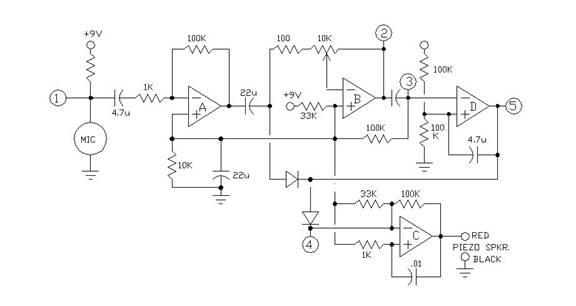
The circuit was built around a quad op amp (LM324). Sections A and B form an audio amplifier. The variable 10k pot controls the gain of the signals provided by the microphone.
Section D is a timing circuit which is triggered by the output of the amplifier. When triggered, the output of D produces a negative-going pulse of about 1/2 second. This pulse enables the audio oscillator while blocking the signals from the microphone.
Section C, the oscillator, produces a tone which drives a piezo speaker.
The pulse at point 5 could drive a relay to move heavier objects, such as something to pound on your neighbor's wall when his stereo gets too loud (This circuit can potentially train other stupid things besides dogs).
A dog hears a soft sound and then barks. By connecting the above-mentioned relay to a recording of a dog barking (or of the action of a 12-gauge shotgun chambering a round), you could offer to replace your neighbor's dog. The duration of the pulse can be increased by increasing the 4.7uf capacitor.
By replacing the microphone with some other stimulus at point 1, this circuit could become a general-purpose burglar alarm.
I don't know what you could do with the oscillator. You might use it to modulate a low-power FM transmitter, so you could produce an alarm tone through a nearby FM receiver.
In spite of its versatility, this circuit is very gentle on battery drain, and can be powered by anything between about 5 and 12 volts. This makes it a good candidate for remote or camping alarm applications.