Sanitation, Health
Phase 1 Sanitation, Health
Health, comfort, and social convenience hinge upon this commodity.
While doing construction in the Colorado Rockies (twelve hours a day and six days per week) I was camping next to a stream. I would dig a hole as deep as my arm would reach, kick in a little dirt after each usage, and finally fill in the last six inches. Each hole served as a latrine for at least two or three weeks. There were no smells, no insects, and the posture itself was more natural to the human body than that of our porcelain-padded cultures.
Studies show that under such conditions aerobic bacteria eliminate pathogens and odors in the material itself with in a very few months, leaving clean and valuable compost. I would suggest that trees would be the optimum beneficiaries of such activities in that there would be less probability of later excavations nearby. Theoretically it wouldn’t matter after a few months – but still.
Phase 2 Health, Sanitation
Pit toilets are pretty standard throughout most of the developing world, but we need to work on this one. At the very least, such systems should be designed so they could be conveniently pumped when necessary.
Recycling facilities and responsibilities would be designated at this level.
Phase 3 Health, Sanitation
Comprehensive recycling would reduce all waste to useful components. There would be a limited amount of storage for items or substances with no known value or ability to recycle, until such time as quantities and technology made them useful.
In spite of the advantages of composting systems, a phase 3 lifestyle would doubtless demand a sewer system, and its ultimate layout should be designed in from the outset.
It may be practical however to have such a system dedicated to human wastes alone, with grey-water systems run separately. It might further be practical to have the individual household systems perform initial composting, but be periodically flushed to a centralized plant. This could save an immense amount of water. Some cultural adjustments may be required in all this, but these concepts should be explored.
Sewage itself would be reduced to fertilizers, fuels, and petrochemical replacement compounds. This may seem somewhat repugnant and difficult to imagine, but even with existing technologies the digestion of solid wastes can be complete, odor-free, and completely sanitary.
Beyond this, existing land-fills would eventually become valuable mining resources for the various materials from all over the globe that have been accumulating for a century or more.
Bath Pan STAT=3
I did an experiment for a couple of weeks in which I bathed using two gallons of solar heated water diluted to a usable temperature with cold water. I was very surprised to find that this was more than enough for a good bath and rinse.
What was merely intended to demonstrate comfortable sanitation with a small amount of solar-heated water, also proved that water a couple inches deep can provide a very thorough bath.
I haven't tried this yet, but I would expect that a limited amount of laundry could be done in this same unit.
Within a 4'x 8' base frame of a pre-fab panel shelter, I framed a 24" x 36" box with a gently sloping bottom of 3/4" plywood. When fitted with a drain, and lined with a rubberized roof-coating, the 4'x 8' shelter had a bath tub. Now of course I had to test it before I could write about it: I discovered that although 24" x 36" is large enough for a 6' x 170 lbs man, it's also small enough that the bath gets shared with nearby walls etc.
A very practical variation of this pan it to simply buy a plastic trough designed for mixing cement, from your local building-supply store. This way you can bathe out on your front lawn and leave your dwelling dry.
What I did try however was using this system inside a 16’ dome while camping. It was very pleasant to enjoy hot baths from solar and camp-stove heated water in the late afternoons after a day of tourism and play.
Lessons from these experiments could be scaled to virtually any level of existence.
Bugs
The first line of defense against bug-infestation would be in construction techniques themselves.
Tightly sealed and caulked joints limit access to almost anything. Such practices should be employed at every phase of construction.
Structures built off the ground on pillars allow limited access to crawlers, and if the pillars themselves are exposed to light and air, they would also offer free access to crawler-eaters such as mice and reptiles.
Spiders such as the brown recluse and black widow consume cockroaches, and although you may prefer the roaches, the spiders at least will not infest your food.
Fly traps STAT=2
Maybe it's like the crackle of mosquitoes as they enter the high-voltage grid of a U.V. lamp on a patio, but there's a certain satisfaction in not being totally helpless against invading swarms, without using bug poisons.
As a child I remember -- I think it was my grandfather – setting up this fairly simple screen box that protected our picnic from at least some of the flies.
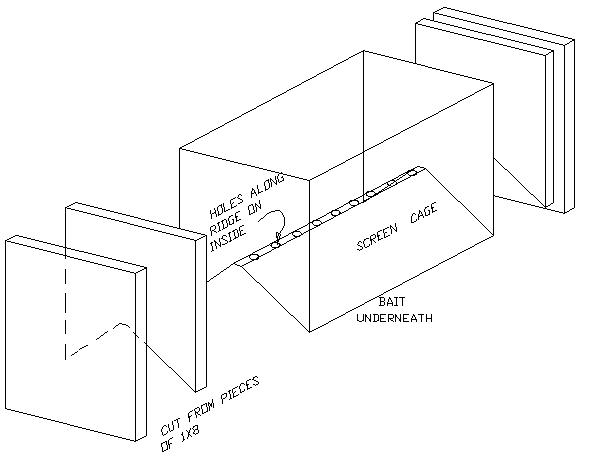
The box is set over some bait, about 3/4" above the surface. A percentage of the flies, after their final meal, travel upward through the holes along the ridge in the center of the box, and never find their way out. I was told that it would be even more effective if the top surface was made of glass.
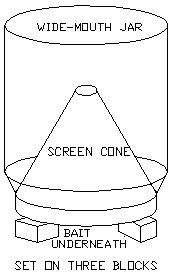
A scaled-down version of this I plan to try when the need arises would be simply a wide-mouth jar with an inverted cone of screen inside.
Steam cleaning
Somehow, despite best efforts, insects sometimes find a way. If you had a portable device that could blast high-temperature steam into cracks and crannies, you could effectively rid yourself of the problem without poisoning the environment.
Creosote etc.
Creosote is a product condensed from heated wood, and contains all kinds of nasty things that can seal cracks and preserve wood. This is the stuff you see on wooden telephone poles and railroad ties, that limits destruction by bugs and birds. Such compounds could be produced by a technique described in “Petrochemical Replacement”.
Medicine
This is a field I know nothing about. I only perceive that I have been my healthiest and most creative in periods when I was intimate with a garden and daily sampling things picked seconds before consumption. This may all be in my head, but such was my impression.
I suspect that people knowledgeable in such things have a repertoire of herbs they can grow that do help. I would love to see such an expert in action, and to see the results first hand.
I generally go to doctors when I have problems, but am chronically reluctant to take the drugs and pain-killers they prescribe; I am also too forgetful to stick with vitamins – hypocrisy no doubt.
I do have to confess however that I have witnessed and experienced dramatic healings in the name of Jesus, and in intellectual responsibility I cannot ignore such experiences.