Infrastructure
Change is Inevitable, How Things Change is Negotiable
The U.S.A, with a little less than 1/20th of the world's population, consumes 25% of the world's energy, and about 22% of the global GDP. This makes our lifestyle highly dependent upon the love of a world one fourth as rich as we are, and the wars we fight to keep them loving us. In addition, 80 to 90 percent of our energy is in the form of fossil fuels. So even if the world did maintain it's ardor for us, we would still be faced with skyrocketing prices and eventual energy bankruptcy. Now consider the possibility that not everyone loves us, plus the increasing instability of an overpopulated and politically fermenting world.
It appears, that the GDP (22%) closely tracks our energy consumption (25%), therefore the ultimately inevitable loss of fossil fuels (80 to 90% of our energy) will reduce our prosperity by a factor of at least five. This would put us a little below the global average if nothing else changed. Modern convenience, as we know it now, is indeed in a precarious and terminal state.
Most of us generally assume that the target replacement infrastructure would be much like the one we now enjoy; I don't believe that this is even desirable – let alone possible.
Studies have found and many observed that once basic needs are securely met, there is little correlation between wealth and happiness. It is essential therefore that we learn how to insure provision of our basic necessities while using a fraction of the natural resources we now consume. In the long run, we will need to reduce our energy and non-food commodity needs by 80% or more. Clearly, this would translate into a lifestyle very different than that we now enjoy. It is not a question of if we are going there, but of how.
Priorities
Corporations and governments are machines. Machines do not care if people live or die as long as they are supplied with power. Certainly there are people within such institutions who care, but how often do you meet someone who cares as much about other people as they care about themselves. With a few sterling exceptions (like Moses, and Gandhi perhaps), people of wealth or power waste an inordinate amount of it upon themselves. It is unrealistic to believe that global and federal politicos are as interested in the well-being of individuals, as they are in using them to build more power and wealth for themselves. We are forced to observe that very few people are likely to have your best interest at heart like you do.
There are beautiful exceptions to this and they center around family. The closest of such unions are between a man and a woman committed to each other and to dealing with the world as a unit. This extends readily to the children they produce and nurture. In the natural course of things the hearts of grandparents are committed to the nurture of children and grandchildren whatever their age.
This sense of family can have many expressions that do not involve blood relationships. It is touching to see homeless poor sharing their meager resources among a close group of friends. This fellowship of poverty can develop a deep sense of community that is mutually protective. Men who have fought side-by-side in mortal combat often form life-long relationships. Young people growing up and learning about the world together share a special bond. People of similar cultural, ethnic, or religious experiences can form very solid relationships.
As a young man I had run out of money in a developing nation and had to teach English for a living for a couple of months. During a visit to the market place my eyes met the eyes of a local Indian and we immediately began worshiping God together. Here was this long-legged Euro thousands of miles from home encountering a man at least foot shorter in a small village at over 9,000 feet in elevation. We were total strangers in every respect, except that we both knew the same Jesus. The Holy Spirit of God provided the mutual recognition, and it was as if we had known each other all our lives. I would have protected and helped him in any way I could. Another touching thing during this period was that the locals could tell that I had no more than they did, and cultural and ethnic barriers seemed to melt in the fellowship of poverty.
An individual may be able to survive, but what's the point? Survival is not life; Love and relationships are. This does not preclude solitary periods where we must explore personal strengths and weaknesses and contemplate our relationships with God. But ultimately God intends that we relate somehow with other humans. This process can be a little more difficult for some than for others.
Prepare your heart for relationships, and if the geopolitical concerns expressed earlier make sense to you, you might consider a little technical preparation to share as well.
Motivation
Viet Nam was becoming a busy place, and it was only a matter of time before I would be drafted and forced to serve two years of fighting on the ground in a country full of people who hated us. But until I received an envelope from the government that said “Greetings” (perhaps one of history's sickest jokes), I still had a choice: I could either walk off the plank and dive into the water with a little dignity, or be ignominiously pushed off the plank. Upon checking with the local draft board I found that I had only one month to “live”, so I ran out to California and joined the Navy Reserve – still a two-year obligation, but with more travel, better food, and fewer dangers.
The point of all this being that most of us still have options as we watch society and infrastructure deteriorate around us at an ever-increasing rate. We can begin to adjust our lives for a preferred landing, or we can simply enjoy our swim as we go down the toilet with everyone else.
Many no longer have these options. For a variety of reasons – some of their own making and some not – there are many who have nothing left to live on. Some have meager government checks, but even some of those are suffering delays and cutbacks as politicians fight over shrinking government revenue. What then?
Could this happen to you? I was a well-paid in electronics in Orange County when the Berlin wall fell. Soon major aerospace companies were laying off big-time. $70,000 engineers were living in their cars in a matter of months. Any advertised technical position had three hundred to five hundred resumes to deal with within two days. For my part I was soon spending my days going door-to-door through industrial areas looking for problems to solve. I remember how humiliating it was to accept a temporary position for just $15 an hour. But after awhile it was McDonald's?, Knotts Berry Farm?, anyone?, anything? Nothing. I used to smugly proclaim that “If a person really wants to work they can find a job.” I know better than that now. Eventually my wife, my two youngest kids and I had no place to live. We had fallen out of the system, and we now know first hand that we cannot take our culture and infrastructure for granted. Living with friends who didn't want us there, a campground, a driveway; It was tough.
If we had owned so much as a driveway things would have been better. We would at least have had a place to exist as we reinvented our lives. Situations unthinkable from the perspective of our normal American lifestyle become daydreams when you have nothing.
There are two things that clearly need designing: An alternative to our existing infrastructure, and a path whereby this alternative can be implemented.
Defining an Alternative
Reinventing the world is a serious chore, and I don't recommend taking it on if you have something more important to do, but some of us get bored a little more easily than others. When I design something I begin with “What do I want?” I don't complicate it with stupid questions like “Is it possible?”, “Does anyone care?” or anything else that might rein in creativity.
I see three general categories of design needed – each with its subheadings with endless details for each of those:
1. There is the physical structure that makes its survival independent of surrounding economic conditions and the need for materials from distant parts of the world.
2. There are the relationships with the existing social, technical, and economic systems.
3. There are the internal concerns that define the culture and manage the physical attributes.
Physical definition – Scale
We could minimize control by local and global economies, by creating a local world small enough for us to manage. Consider a village surrounded by enough land to support its inhabitants. The land must all be close enough to the central cluster of buildings to be accessed within about 5 to 10 minutes of walking. This would amount to about a quarter-mile radius – let's call it a half-mile square. This limitation defines a maximum physical size, and would make it manageable without motorized transportation.
The maximum population of this village would be determined by the carrying-capacity of the land – to include such things as the fertility of the land and water available. To provide for emergency situations and for giving to others, the population should never exceed more than half the number that the land was capable of supporting.
A group of closely involved people should also be small enough to know each other at at least an acquaintance level. This in itself could limit a local population to about fifty or sixty people regardless of the capacity of the land. From these maximums, the scale and population could extend downward to a handful of people living on a city lot.
The amenities available will be closely tied to scale. It would important to consider the dangers and advantages you may experience as you involve different numbers of people.
A larger population would be managed by cloning locally sustainable villages within a region. There could be additional benefits at this level, such as:
Mutual protection
Combined economic and political power
Development of alternative transportation links
Broader availability of specialized talents and manufacturing
Physical definition-- Energy
At least 70% of the petroleum used in this country goes to transportation, so by obviating the need for motorized transportation we have lopped off a major portion of our energy needs. When you consider the streets, driveways, parking lots, gas stations, garages, and stores supporting the transportation infrastructure, you have consumed more than half of our downtown real estate. By eliminating such vehicles we have just physically shrunk our town by at least 50%.
From a regulatory and financial standpoint you have eliminated all the laws pertaining to motor vehicles, all the expenses of purchase, maintenance, fuel, insurance, etc. and the environmental impact of the whole mess. By eliminating the need for personal motorized transportation we have freed ourselves from a major portion of our income needs.
This need not disconnect us from the rest of the world. A micro-rail or foot path could connect from the village to transportation links on the perimeter. If desired, cars could then be rented for out of town travel at a fraction of the cost you would have paid to maintain a vehicle full time. An access that eliminates entry by conventional motor vehicles greatly inconveniences dangerous visitors. As in a gated community, no one enters or leaves without knowledge and permission.
Locally produced energy would likely include solar, but a wood lot grown for combustible biomass would provide a reliable backup. For those who worry about a carbon footprint, trees growing and awaiting harvest would sequester many tons of CO2 from the atmosphere. They would then be burned at a rate less than or equal to the rate of growth.
Since the amount of copper required to carry a given current increases with the square of the distance, distribution of power from a village power plant would be very economical. This may make it feasible to use a system of 48 volts or less, greatly reducing shock hazard, a mountain of governmental regulatory concerns, and the taxes & fees associated with them.
Physical definition-- Structures
Earth-based materials would likely dominate for walls and floors, and some wooden components could be derived from on-site growth. A village kiln could supply specialized bricks, tiles, and other useful ceramic shapes. Adequate conventional construction materials would be available in most areas, and there would be no reason to ignore such resources. Keep in mind that with the limited scale, construction materials would not be an on-going need.
All-in-all such a self-contained infrastructure could be immune to the economic winds of the surrounding worlds. Little government involvement would be needed, and unwanted governmental attention would be difficult to impose.
Relating to neighbors
I have heard many wannabe survivalists speak of running to the hills or some other remote area where they felt they could make it. Forget it: One forest fire would ruin your whole day. The whole problem revolves around too many people and too little space. The reality is that you are going to be around people no matter where you go – even if its survivalists thinking they are being original. It is far wiser to face the fact that there will be thousands of neighbors, and to deal with it.
An alternative infrastructure would have a lot to offer the surrounding community during difficult economic times. Teaching others the technologies of local sustainability could spawn independence in the entire region. If you've done your math right, you could be producing extra food to help with surrounding emergency needs. The community could also be an educational resource to prepare children in local schools for the future they will face.
It would also be OK to connect economically with the existing infrastructure, as long as dependencies and governmental entanglements do not develop.
The infrastructure itself would work towards a sustainable equilibrium with the environment. There would be no basis for complaints in this category, nor for the intervention of environment-based laws.
Internal concerns
Group resources are important for any community. Things like water, waste disposal, and a community meeting place would clearly be in this category. Beyond this, there is a balance between private ownership and mutual benefit among those close to you.
People would be aware of the importance of the work they were doing, and would recognize their dependence upon others. It will be easy to see who is carrying their load and who is not; in most cases, you will know them by name. To some degree, everybody's business is everybody's business. People who are not doing their part will be a burden for everyone, and soon receive either the help they need, or the pressure to move on.
In a highly visible environment, there would be few suspects and many witness for any criminal activity. There would be no place to hide. “Jail” in such cases would be defined as anywhere out of reach of community influence. People would be forced to live or die with the reputations they had earned. The arrival and departure of strangers on foot or via the access corridor would also be highly visible.
Since technology is politically neutral, such an enclave of economic independence could provide a platform for almost any style of government or culture. For those with the wisdom to listen however, history does have some important lessons. There is no more consistently proven economic failure than government-mandated communism. In our own nation's history the first year of the Mayflower adventure was a highly socialized disaster. From this they recognized the affect of private ownership on productivity, and did much much better thereafter.

Finding a Path
The most important vehicle is flexibility. The path itself depends upon your starting point. From there it will have variations depending upon the resources available, your personal intensity, and the people with whom you become involved.
My best effort at dealing with so complex an objective is to define a milestone easy enough to be achieved by an individual or small group, yet established enough to be of benefit. This is is not a one-size-fits-all, but a potential meeting point along the path for many of us. So we are looking for the lowest common denominator, with the greatest potential for scaling upwards in population and comfort.
This target must be approachable both by destitute people looking for a place to live, and by established individuals preparing for ministry or emergency.
A Target Milestone
A conference-ground style village would provide the most flexibility for the least cost. This would center around a common structure for cooking and social interaction, surrounded by individual sleeping arrangements. Such an arrangement can literally begin from nothing.
I spent a few evenings at a campfire with a small nomadic group in an Arizona desert. They ranged in age from old (but none decrepit) to young families with small children. They all seemed healthy and happy. They shared a simple one-pot meal prepared on a dilapidated picnic table behind an abandoned building, and I was touched by their hospitality.
For hours into the night we would exchange stories and laughter around the campfire, with occasional serious lines from their leader – an energetic man with a rich white mane of beard and hair. Eventually they would fade off into their respective nests in old cars, pickup beds, and on the ground itself, and I would walk to my own camp about a mile away – a little torn by my refusal of their invitation to join them.
More recently I was involved with homeless living in camps sparsely strewn along a riverbank in California's central valley. A small group of Christians would haul out equipment and food on Saturday mornings and prepare breakfast for all who were interested.
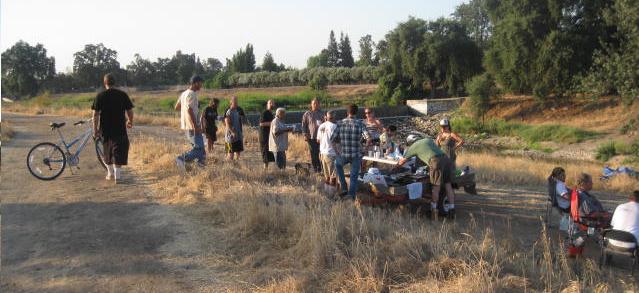
Involvement was intensified when one of their number died from the heat. Kenny had been in prison on medicines that required him to live in temperatures of less than 80 degrees. Due to state cutbacks, he was one of thousands who were released early, and was told to go live at “the river” during 103 degree summer days. Of course he soon died and the state benefited from a reduced financial burden.
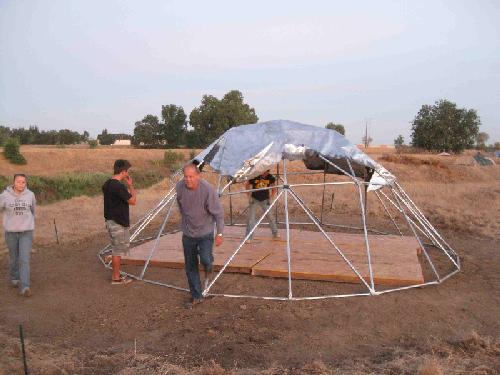
We developed a cooling center which we named after Kenny, and began providing shade and ice water. The first structure was a 21' diameter dome which was soon augmented by other donated structures; the complex was manned by Christians from among the homeless.
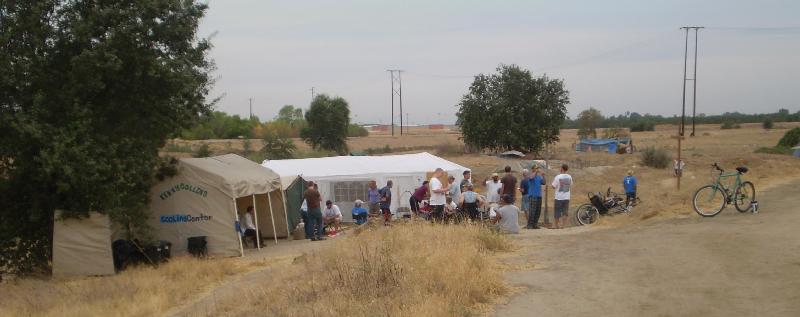
Being the closest to the road, it became the distribution point for donations to the rest of the homeless camps. The camp itself soon enjoyed a high quality of sanitation, showers, and a 30-gallon tank refilled by water hauled in 5-gallon bottles. Women had a place of protection, and various other forms of ministry emanated from this camp. Some had low-paying part time jobs, and some scoured the town for recyclables; even a few dollars a day was comfortable living under these circumstances.
One morning I visited the camp and heard how the night before they had hailed a young couple pushing a shopping cart along the levy. It was cold, and in the cart they had two blankets and two small children – one only a couple months old. They simply had no place to sleep that night. The Christians brought them to the fire, fed them, made a tent available and provided enough blankets and sleeping bags to keep them warm. They took care of them for a few days until better arrangements could be made. This was a case of people who had almost nothing sharing out of their poverty to assist others who were even less fortunate.
Other advancements in comfort and ministry were underway when the city and county combined harsh new laws and brutal enforcement to drive homeless from the whole area. Once the eviction notices were served things deteriorated rapidly. Key leaders found other places to live, external assistance began to serve elsewhere, and drugs and other vices began to creep in.
Obviously governmental regulations are a force to be considered, so we need to minimize opportunities for conflict. Besides discretion and concealment, use components that are temporary, portable, cheap, and environmentally benign. Such constraints also reduce cost and add flexibility. Pre-assembled kits and hardware packages can be created for emergencies – your own or those of others. Standard camping equipment is helpful, but larger-scale components that could help a group would have a multiplying effect. If a number of individuals had such components prepared before hand, a disaster-stricken area would be well served by the victims themselves long before FEMA could interfere. In addition, they would enable people to live comfortably on their own property as they rebuilt their lives.
For example: as of this writing, the 21' dome frame mentioned above is stored as a bundle of struts that could be assembled in a half-day. This or a similar structure could provide emergency shelter for a group of people in need, and serve as instant kitchen/city hall. This type of item might be within reach of a group of people with sub-standard resources, or an individual with any reasonable income.
For a practical milestone infrastructure, consider the following:
A pre-fabricated structure big enough for cooking and meeting of at least a dozen people. This could also provide for immediate emergency sleeping. A population of ten or twelve would be a good place to start.
Although individuals would be the responsible for their own sleeping shelters, a supply of 10' X 12' tarps and wire or rope would be easy to purchase and compact to store. You can buy #18 gauge wire in ¼ mile spools.
There is a technology available for a virtually smokeless wood-fired cook stove that can be built for less than $50 (see technosmith.com). Some variation of this would serve well for a group kitchen or for space heating as needed. This would optimize the use of renewable fuels and scavenged debris – or anything combustible for that matter. Please don't forget the matches.
The 30 gallon water tank mentioned above was no more than a new plastic trash can with a spigot installed near the bottom.
An auger capable of putting 6” or 8” diameter holes down to a depth of 5' or more would answer a major sanitation concern. Kicking in a little dirt after each usage would eliminate odors and insects. With standard 1/2” galvanized pipe extensions, this same tool could be used to put down a shallow well.
A shovel, a pick, and an assortment of common hand tools would be essential for setup and ongoing development.
Beyond the above, the most valuable item would be a notebook or library of information on additional technologies for longer-term sustainable living.
These items were being accumulated by my friends at the river, until they were shut down. Such a package could serve for instant community if you ran across a group of people who needed one. The flexibility would allow you to plant it in your backyard if your house blew away (and left the package), and then to move it somewhere else if needed.
We have just defined a lifestyle that runs on a small fraction of the cost of the mainstream infrastructure – albeit at a reduced level of comfort and convenience.
On private acreage this could provide a comfortable campground center where a group of friends could stay for a day or two of refreshment, or to develop additional comforts. Neighbors permitting, destitute friends would be able to take up long-term residence as they rebuilt their lives and participated in further development.
One lesson learned from “the river” is that if a community is to have a religious focus, it must be intentional, and if the facilities for are donated from the outside, leadership should be donated from the outside also. From this point it would be a matter of incremental exploration to develop a stable long-term lifestyle that could expand to meet local needs or spawn related communities as population pressures increased.
The Land
Care must be taken to make this low-cost lifestyle as locally sustainable as possible, or it could easily evolve into a poorer style of slum. It therefore must control enough agricultural resources to provide its own food. This reserved land would restrict population densities and protect a supply of food no matter what the rest of the world was doing.
During a recent search of the internet I asked how much land is required to support a person. Although this would obviously depend upon many factors, the number that came up several times was one-eight of an acre. This confirmed an earlier reference I had come across that spoke of a family of four in China living off one half acre (This was a little puzzling in itself in that I didn't know that a family in China could legally be larger than three). Until I know better, I will accept one-eighth acer per person as a minimum, and design around a minimum of twice that.
Energy sustainability must also be considered, and an important part of that will be burnable bio-mass (wood). I would have to be even more arbitrary on this one, but to be sure we would have enough, I would suggest reserving one fifth of the land for these purposes. If this amount proved extravagant, part of it could be planted with fruit trees to provide both food and wood.
In calculating percentages for living spaces, energy production, food (2X the minimum), and common areas, I would recommend about one third acre per person.
Taking Action
I recall an old-timer critically examining a rope I was intending to use in a particularly dangerous application. I assured him that it was a good rope. He responded with: “It's a great rope – till you pull on it.” Especially upon observing that this old man was a tad crippled, I figured that I had better pay attention. Theory is nice, but there is no teacher quite like experience. There are many technologies available for meeting the basic needs of food, shelter, etc. But if you don't gain experience in these areas, they will do you no good. You need to buy your ticket before you board the plane. So if you find all this interesting, don't kid yourself about knowing anything until you've actually begun to build something.
This
exercise is for those moving forward into the future, rather than
accepting their current paths as casualties of history. If some of
these concepts seem un-American, consider that any resemblance to
America is purely coincidental. We are trying to achieve something
more honest, fair, and universal than Hollywood and politics. A very
different paradigm will be needed. Some of the necessary changes may
be quite offensive to some in modern cultures, and it may take
exceptionally rational minds to consider them seriously. It is
obvious, that if we don’t begin thinking
differently,
we will never do
anything
differently.
Local
sustainability was the general rule through the first half of the
19th century. It is true that key centrally-manufactured goods were
increasingly common, and were developing dependencies in the
metropolitan areas, but with a few key exceptions, the rural areas
and widely-separated towns depended little upon outside help. Local
self-reliance faded quickly however, in areas that had access to
railways. The transportation systems that have unified the globe and
made all its resources available everywhere have made people slaves
of global economics and politics.
The path to sustainabeity then,
begins by stepping backwards in time to consider the components of an
earlier period, and then creating a new “history” down a
different path that does not include needing distant resources. We
need to bring modern tools, sciences, and creativity to bear on
technically sophisticated answers to age-old problems.
As the existing infrastructure is eroding, material shortages and political convulsions continue to rock the economy. Historic and current events tell us what happens as infrastructures become overloaded with people and conflicts: The poor get poorer, and crime gets more powerful and organized as it replaces a failing government. In some parts of the world feudal war lords compete for turf, relatively undisturbed by the threat of any government intervention.
We need islands of stability that offer no motivation for disturbance by either governments or thieves. There is nothing significant to steal in an economy that depends little on money, and its productivity would disappear if there was an attempt to enslave it from the outside. On the other hand it could be a tremendous source of stability, blessing, and education to those within reach who are willing to learn.
Links: Rebuilding Culture Infrastructure